找回密碼
 新用戶註冊
搜索
熱搜: hifi av 音樂
查看: 6871|回復: 19

[CAS] 真正CAS系統

[複製鏈接]
發表於 2014-1-26 17:43:08 | 顯示全部樓層 |閱讀模式
20140126_153904.jpg
20140126_154110.jpg
20140126_154140.jpg
20140126_153609.jpg
20140126_153706.jpg
20140126_153740.jpg
20140126_153825.jpg
真正CAS重播系統並不多,市面上一般是由播放器至解碼的產品。由訊源到音箱的一體設計並不多見。
Grimm LS1是集荷蘭幾個工程師之力而完成的精品,從外型到使用到聲音質量都在頂尖之列,各大音響展均得到好評。
Grimm 是設計專業音頻產品的公司,之前最受行內贊賞的產品是:
Grimm Clock 及Grimm AD1, 兩者都是搭棚式設計。前者廣泛應用在數碼音頻及數碼影像上,為眾多不同數碼儀器提供一個中央主時體鐘;後者是DSD轉碼器,是首間沒有用專利的設計,現時很多SACD 錄製都是出自這機器的。
Grimm LS1雛形大概在兩年前形成,當時主要用家是錄音室,後來再加上遙控器及低音單元,變成兩個系列,家用及錄音室均可。錄音室應用是多了接口至midi 器材,方便音樂創作。
LS1是對有源音箱,amplifier 是自家Hypex Ncore, 內置時鐘是自家Grimm Clock, 有模擬及數碼輸入,一對音箱靠一條CAT5光纖線傳遞訊號。
作為CAS系列,最重要是跟電腦接駁,Grimm 提供一塊小小介面,透過USB接到電腦,無論是Mac或Windows, Grimm 都有自身的驅動程式,介面另一端用CAT5線與音箱相連,換言之,電腦音頻輸出時的時鐘訊號由音箱內的Grimm Clock主導,這也是錄音室用電腦錄音及播放而又不受電腦噪音影響的公開秘密。介面另一作用是對音箱作出不同設定,如分頻點,左右頻道互換。。。
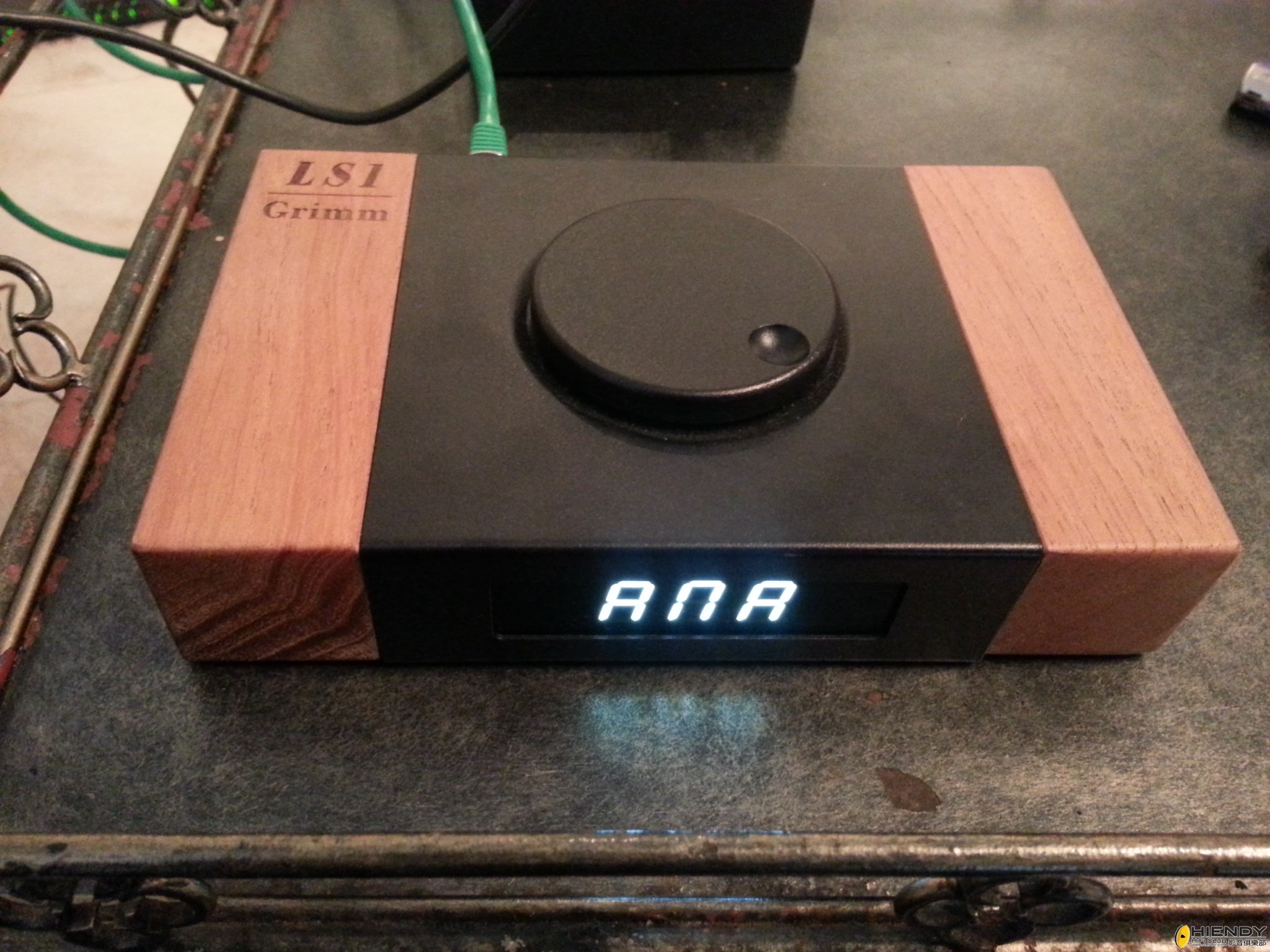
介面又接駁至一個漂亮盒子,用來控制音量。音量對音質影響很重要,Grimm 有專門軟件調節,詳情請上他們網站看。
LS1的基本設計只有兩分頻,但低音可下潛至40Hz, 若要低至20Hz, 可加上他們的低音單元,如果家裡低頻陷阱不多,單元可放在音箱底部,不佔地方,若情況不容許,可將低音單元移至牆邊以得到更佳效果。
這對音箱在聲學設計上很有特色,其建議擺放是45% toe-in, 主要是其設計的off-axis跟on-axis相差不多,45%toe-in的效果是皇帝位寬了很多,兩三人並排坐也可。

評分

5

查看全部評分

 樓主| 發表於 2014-1-26 17:48:44 | 顯示全部樓層
20140126_174555.jpg
回復

使用道具 舉報

 樓主| 發表於 2014-1-26 17:57:43 | 顯示全部樓層
本帖最後由 hkborn 於 2014-1-26 18:08 編輯

20140126_175536.jpg
20140126_175418.jpg

圖中可見時鐘已是Grimm作為source 了。
低頻可選擇40Hz 或80Hz
回復

使用道具 舉報

 樓主| 發表於 2014-1-26 18:26:28 | 顯示全部樓層
本帖最後由 hkborn 於 2014-1-26 18:36 編輯

整套系統不用外置解碼,不用music server,不用外置前級,不用外置後級,只用介面直入音箱。聽黑膠可用模擬直入音箱。
這是CAS正確路向,不用盲目配搭不同產品。

用Cat 5線作音頻傳輸在一般產品比較少見,除噪效果很好,也是Grimm 這間技術型公司才去做。
回復

使用道具 舉報

 樓主| 發表於 2014-1-26 18:43:55 | 顯示全部樓層
"The Grimm Audio LS1 Reference Studio Monitor system sounds unbelievably phenomenal. But when you add the LS1 Sub-Woofer Set to the LS1s, something even better emerges. When listening to the Grimm LS1s with the subs added, I noticed a sound that was not 'effecty' - as if designed for wow-factor; as if to impress someone who truly does not know what they are listening for. Instead, I was suddenly immersed inside a world of music in a way that I have not been before. Using Dire Straits' 'Water Of Love' as a reference (Listen to something you know!) I was able to hear each drum in space. It was if I could reach out and touch each tom-tom of the drum kit. It became blatantly obvious just how valuable these monitors with the subs would be not only in a mastering situation, but I think 'especially' in a mixing application. Why not get it all right from the start? Granted, we're talking about a set of monitors that with the subs, would set one back more than what they have in their vehicle. Still, for the discriminating professional, the Grimm Audio LS1 and Subwoofer Set should warrant serious consideration. I could tell right away that not only could I hear everything perfectly in such a way that I could detect any imperfection and immediately know just what to do with it, that I would enjoy my work in the studio so much more than normal. And if I would enjoy it more, then so would my clients, which is perhaps the most important consideration, after all, isn't it?"

Alan Moon - Front End Audio
回復

使用道具 舉報

發表於 2014-1-26 18:46:21 | 顯示全部樓層
Perforamce???????
回復

使用道具 舉報

 樓主| 發表於 2014-1-26 18:48:40 | 顯示全部樓層


Grimm Audio LS1 (€10,000)

By Keith Howard
This innovative Dutch company provides an active audiophile speaker which is unusually styled and also features sophisticated onboard Digital Signal Processing
So, Grimm Audio is not the most propitious name, in English, for a hi-fi manufacturer. But once the schoolboy giggles have subsided, there are two very good reasons to take this Dutch company, and its new LS1 loudspeaker, seriously.
   Firstly, there are the people involved. The second reason is the LS1 itself, because run-of-the-mill it is not. In addition to being active it has onboard DSP to perform crossover filtering, equalisation and time alignment of the two drivers, making it one of a very small number of audiophile loudspeakers to have exploited digital signal processing thus.
   As you’ll gather from the photographs, it isn’t only this which makes the LS1 unusual. It looks odd with its wide baffle, inverted driver arrangement and half-round extruded aluminium sections, running along the lower edge and to either side of the shallow cabinet, where they also form the speaker’s stand and house the electronics. All these features illustrate ‘form following function’.
   Let’s begin with that wide baffle. We’re so habituated today to narrow front baffles that it’s natural to presume this is the optimum arrangement. Well, Grimm Audio demurs. It’s an issue of directivity – how the loudspeaker radiates sound around it. If you want a speaker to have as wide a directivity as possible then you give it a narrow baffle, whereas if you want to narrow its directivity as quickly as possible with rising frequency you use a wider baffle. Which is precisely what Grimm Audio has chosen to do with the LS1 because it reduces the strength of the first side wall reflections, and thereby – it is hoped – the room’s influence.
   Because the cabinet is wide (358mm across the baffle, 522mm overall) it is also – in order to present the required internal volume to the bass-mid driver – unusually shallow (160mm externally). This has the further advantage of raising the front-to-back internal air resonance to a frequency above the working range of the bass-mid driver. But it also means there is little opportunity to absorb the reflection from the cabinet back wall, some of which will find its way out through the cast magnesium cone of the 220mm SEAS Excel bass-mid driver.

REDUCING DIFFRACTION
In passive speakers an inverted arrangement of bass-mid unit (top) and tweeter (below) is used to equalise the path lengths from each driver to the listener’s ears. But the LS1’s tweeter is below its bass-mid driver, to allow the third piece of half-round extrusion to be fitted along the bottom edge of the cabinet rather than along the top edge, where it would look more awkward and demand a mitre joint to the two side sections. It’s there for the same reason they are: to smooth the change in acoustic impedance that occurs at the baffle edge and so minimise the diffraction effects that result.
   DSP is used to correct frequency domain behaviour only, in respect of both amplitude and phase. Crossover between the two drivers is by fourth-order Linkwitz-Riley slopes, the filters being computationally efficient IIR (infinite impulse response) types with an FIR (finite impulse response) all-pass filter to correct their phase distortion. Equalisation is by IIR filters too, and very simple, low-Q ones at that: only those trends that are present in both the on-axis and off-axis responses being corrected. The EQ is generic, rather than adjusted for each individual speaker, the tight production tolerances of the SEAS drivers ensuring that overall frequency response remains flat within tight limits.
   Onboard A-to-D conversion allows analogue signal sources to be connected but for this review a digital source was used exclusively via one of the LS1’s two balanced digital inputs, which are also compatible with unbalanced S/PDIF feeds via an adaptor cable. Signal connection is made to one of the speakers only, a supplied cable carrying the signal to the second speaker via 8P8C (RJ45) sockets. Each speaker knows which channel to reproduce by appropriate setting of a small toggle switch. Also connected to the first speaker, by a short RJ45 link, is a wired remote control that also houses a receiver for an IR remote handset (not supplied). A rotary control atop the wired remote provides both input selection and volume control, the gain setting appearing as two digits in the display on the remote’s front face.

UNUSUAL TOE-IN
Eelco Grimm and Guido Tent delivered and set up the LS1s in my listening room, and when they’d finished, the speaker layout was as unusual as the LS1s themselves. Designed to be listened to at 15 degrees off-axis horizontally, these speakers are intended to be toed-in such that their axes cross some way in front of the listener, with two potential benefits. First, less sound is fired at the nearest side wall; and second, time-intensity trading (whereby the further speaker gets louder as you move to either side of the optimum listening position) enlarges the acceptable listening area. As John Crabbe showed many years ago in these pages, achieving effective time-intensity trading requires a much more directional output than supplied by the LS1, but Grimm’s philosophy is that some is better than none. As you can imagine, I played with other, more conventional speaker positions just as soon as the LS1’s minders had left, but eventually had to concede that having the speakers widely spaced and overly toed-in did indeed provide the best results.
   It’s natural to expect of a speaker with DSP crossovers and EQ, an unusually flat frequency response, and recording and mastering studios as one target audience, that it should sound neutral to the point of being clinical. That, after all, is what we’ve come to expect from a generation of studio monitors. But the LS1 doesn’t fit this mould. Its flat response endows it with unusual tonal neutrality, no question, and the recommended positioning creates a super-wide stereo image in which the position of every musical strand is meticulously controlled. Yet there is something softened, something less than ruthlessly explicit, about the sound overall. A symptom of this was that I kept finding myself using higher than usual replay levels, attempting to put back what I felt was missing.

A TOUCH TOO EMOLLIENT
I am not, by any means, a devotee of Paul McCartney’s post-Beatles work so I might well have gone my whole life not possessing a copy of Band On The Run, but for the fact that it recently became available in 24/96 form from HD tracks, and inquisitiveness got the better of me. Track 11, ‘Country Dreamer’, begins with a distinctly distorted acoustic guitar in the right channel, followed by sliding bass left of centre, then, eventually, Macca’s first vocal refrain. After 57 seconds, at the start of the second stanza – ‘I’d like to stand in a stream with you’ – the vocal quality hardens: markedly enough to make you wince slightly when listening to a warts and all, high transparency system. Via the LS1s (fed via the balanced digital outputs of a TC Electronic Digital Konnekt x32 professional FireWire audio interface from my Mac mini, running Windows XP and using J River Media Center v15 as the player software) this change in vocal character was blunted. It was still there if you listened for it, of course, but less self-evident.
   As a complete musical contrast I chose Anton Webern’s spiky ‘Rasch’, one of the short movements from his Four Pieces for Violin and Piano (from ‘Mirror Canon’, 2L Records 24/96 download), the quintessence of which is a restless, unsettled – and unsettling – energy. This piece thrives on precision for its impact, in both the playing and the replaying, and isn’t supposed to sound in the least bit cosy. Quite the opposite: it’s a musical astringent that should put your senses on edge, otherwise the intended effect is lost.
   Via the LS1s, that vital precision was lacking. Dynamics and even image focus were a little blurred; a piece of music that should really sock you between the eyes became a touch too emollient.
   Of course, for some listeners this refusal by the LS1 to make unpleasant noises will be a positive attribute. If you like a big sound that errs on the side of caution, this speaker has much to commend it. But if you demand the unvarnished, sometimes harsh, truth, you should probably look elsewhere.

VERDICT
I hope this is just the first speaker product from Grimm Audio because the world needs more of the original thinking and active/DSP design that it embodies. Its sonic strengths are an unusually even tonal balance and, when set up as intended, a wide, deep stereo soundstage: attributes that will endear it to many. All it lacks are the hear-through transparency and whip-crack dynamic alacrity of a true great.

Download Lab Results Online Now!

Originally published in the March 2011 issue

回復

使用道具 舉報

 樓主| 發表於 2014-1-26 18:50:07 | 顯示全部樓層

better listen yourself
回復

使用道具 舉報

 樓主| 發表於 2014-1-26 18:53:00 | 顯示全部樓層
本帖最後由 hkborn 於 2014-1-26 18:54 編輯


回復

使用道具 舉報

 樓主| 發表於 2014-1-26 18:57:22 | 顯示全部樓層
Grimm Audio LS1 and LS1s subwoofer

Grimm Audio is based in the Netherlands, and is the brainchild of four prominent audio engineers. It has forged a strong reputation with products based on tested scientific principles. The LS1 and its partner subwoofer, the LS1s, represent a first foray into loudspeakers, and are the end result of a rigorous development process.

Overview

It’s immediately clear the LS1 is something different: black (custom colour schemes are available), and standing 1.44m tall, semi-cylindical legs support a flat 14-litre sealed enclosure (47x36x16cm HWD) containing two SEAS drivers, an 8-inch woofer and a 1-inch tweeter. System electronics reside in one of the legs and include 48/76-bit DSP, a high-quality digital clock based on Grimm’s standalone CC1, A/D and D/A converters (both analogue and AES digital inputs are available), and two 180 watt Hypex NCore Class D amplifiers. The subwoofer measures 17x34x34cm with the same rounded-corner profile as the LS1’s baseplate. It fits snugly at the bottom of the legs with its 9-inch (23cm) Peerless driver facing upwards and is powered by a 400-watt Class D amplifier.

Controlling the system is a USB interface and software for Mac or PC. In addition to level management the software offers a number of features of interest to professional users, such as left/right swap, the ability to listen to the Side signal on its own and even ‘Ported’ and ‘Small’ speaker emulation modes. An optional wood-ended physical remote with a level wheel and display completes the setup; the ‘press’ action on the wheel can be set to mute or dim playback. The remote provides another two AES inputs in addition to the standard one, so I had my workstation, reference player, and PC’s outputs available and could offset their relative levels if required. Another useful aspect of the remote is being able to set the metering at one’s preferred reference volume, making level-matched comparisons very easy. I’m told there are plans for a ‘pro’ version, making more functions available in hardware, a development that could remove the need for a separate monitor controller.

In Use

The LS1 requires some assembly from new, although separating the main elements in transit makes sense with well-designed packaging protecting what is, after all, a sizeable investment. Taking my time, I needed about an hour to attach the legs to the two speakers’ enclosures, add baseplates and leg trims, position the subs and wire everything up – having checked the analogue input worked as expected, I stayed digital throughout the review period. Although placed as normal at the outer points of a listening triangle, Grimm recommends an angle across the front of the user at 45º instead of the usual 30º to reduce room effects. This looks unusual (and of course conventional positioning is also possible) but it worked for me and sounded best in my studio.

After a day of auditioning and run-in time I took the plunge by using the Grimms for all mastering work arising during their residency, debunking conventional wisdom that two-way speakers are not an ideal solution with possibly the clearest and least hyped presentation I’ve heard. I had that feeling of an open window into sound, across a wide range of music styles.

There is clever DSP in the main cabinet crossover between drivers, and (unusually) I was unable to hear the transition point. This promotes an extraordinarily well-balanced top-to-bottom staging of audio, and it’s been said the LS1 sounds in some ways like an electrostatic speaker but with none of the flaws. Don’t get the idea it just makes everything sound good though: while somehow remaining immensely listenable, you’re left in no doubt as to what is and isn’t working in a mix.

Switching in the subs from the remote application extends low frequencies down to 20Hz and increases the available headroom, crossing over at a DSP-controlled 70Hz. Although this works well, it’s likely to be most useful in larger spaces than mine: in my 30m2 room at typical mastering volumes I was happy with the LF provided by the LS1 pair alone and, perhaps surprisingly, didn’t feel a lack of low end resolution despite a gentle rolloff below about 40Hz. The LS1 is protected by an excursion limiter (as with other functions this flashes an LED in the dot of the i of ‘Grimm’ in the cabinet’s logo, a neat touch), and I had to increase gain by about 20dB over my usual reference level before it engaged, and a few dBs more with the subs. Bearing in mind that I was testing with bass-heavy material, I can safely say the system plays loud enough for the majority of users.

Conclusion

With or without a subwoofer, the LS1 is a special loudspeaker. Quality costs, as usual, but you’re getting a number of facilities (amplifiers, converters and monitor control) that might require additional outlay with a more conventional setup. In over a decade of reviews for this magazine I’ve heard only one system to rival the Grimm, and that was more than twice as expensive: I’ll be genuinely sad to part ways at the end of this particular loan period, and would urge anyone looking for a true audio monitor to give the Grimm Audio LS1 a listen.

www.grimmaudio.com

Review: Nigel Palmer - See more at: http://www.audiomedia.com/gear-& ... thash.5bSHN2yS.dpuf
回復

使用道具 舉報

發表於 2014-1-26 19:13:23 | 顯示全部樓層
Thanks.....
回復

使用道具 舉報

發表於 2014-1-26 20:34:23 | 顯示全部樓層
賣晒而家啲機,換一套grimm,慳唔少
回復

使用道具 舉報

發表於 2014-1-26 23:15:37 | 顯示全部樓層
hkborn兄,
謝謝產品介紹,如果用「CAS — 整合解決方案」可能更加對題。
也可避免如何界定何謂真正、何謂不真正。
回復

使用道具 舉報

 樓主| 發表於 2014-1-26 23:20:55 | 顯示全部樓層
Grimm的這套系統真的很全面,連箱體設計也很特別,baffle 面,高音單元放在中低音單元下面,這在二分頻設計比較少見,一般高頻會在耳朵水平的高度,但它卻低了一大截。
另外圓柱側旁承托也考慮了聲音擴散及避震作用。
軟件開發也不簡單,年多兩年來看著他們不斷在改善,很多所謂高級音響連買個專利權,做自家名稱的驅動程序都不肯,怎能有好的聲音?
聽了一個下午,最弱一環仍是低頻。。。。。。。
回復

使用道具 舉報

 樓主| 發表於 2014-1-26 23:34:12 | 顯示全部樓層
本帖最後由 hkborn 於 2014-1-26 23:54 編輯
k500a 發表於 2014-1-26 23:15
hkborn兄,
謝謝產品介紹,如果用「CAS — 整合解決方案」可能更加對題。
也可避免如何界定何謂真正、何謂 ...


標題是有感於很多時產品說是CAS,卻又認為電腦是噪音之源,真的可以直駁電腦,用電腦聽歌的CAS產品少之又少。
是否真正CAS還是可以辯論的,前提是對CAS有共同界定。
電腦在錄音界是主要生產工具,如所謂噪音不被克服,那如何做錄音及mixing, 主要解決介面接駁,普通電腦完全可作高端音源。
回復

使用道具 舉報

發表於 2014-1-26 23:42:48 | 顯示全部樓層
hkborn 發表於 2014-1-26 23:20
Grimm的這套系統真的很全面,連箱體設計也很特別,baffle 面,高音單元放在中低音單元下面,這在二分頻設計 ...

有無LS1s試埋?
回復

使用道具 舉報

 樓主| 發表於 2014-1-26 23:46:42 | 顯示全部樓層
有,入咗倉成年,遲d拎番屋企試,呢排聽黑膠多。
回復

使用道具 舉報

發表於 2014-1-27 06:55:49 | 顯示全部樓層
港生兄,

我是Grimm 時鐘用家,對他們產品頗有信心。
這套喇叭直接用PC 接就可以,把系統大大簡化。
不過看樣子可能要用subwoofer。
bjmanavitorsmall (160x127).jpg
回復

使用道具 舉報

發表於 2014-1-27 13:57:10 | 顯示全部樓層
可能要用subwoofer X 2
回復

使用道具 舉報

 樓主| 發表於 2014-1-27 14:16:53 | 顯示全部樓層
chowhwk 發表於 2014-1-27 06:55
港生兄,

我是Grimm 時鐘用家,對他們產品頗有信心。

在華語世界,周兄關於Grimm Clock之鴻文甚有參考價值。
兩分頻自然比不上三分頻,加上低音肯定令整體聽感豐厚一點。
不過說實在的,個人嫌Grimm分析力還是不足,適合家用多於錄音室。
昨夜還試了模擬輸入,那是直入音箱,然後用那漂亮小盒子調較音量,感覺像用Wedgewood喝茶。
夜深一點一點的去調節音量效果跟日間不同,敏感得多。
回復

使用道具 舉報

您需要登錄後才可以回帖 登錄 | 新用戶註冊

本版積分規則

Archiver|小黑屋|聯絡我們|刊登廣告|Hiendy.com 影音俱樂部 一個屬於音響愛好者的家

GMT+8, 2026-8-9 15:48 , Processed in 0.039425 second(s), 21 queries .

Powered by Discuz! X3.5

© 2001-2024 Discuz! Team.

快速回復 返回頂部 返回列表